Who Owns ChatGPT? OpenAI's Ownership Explained
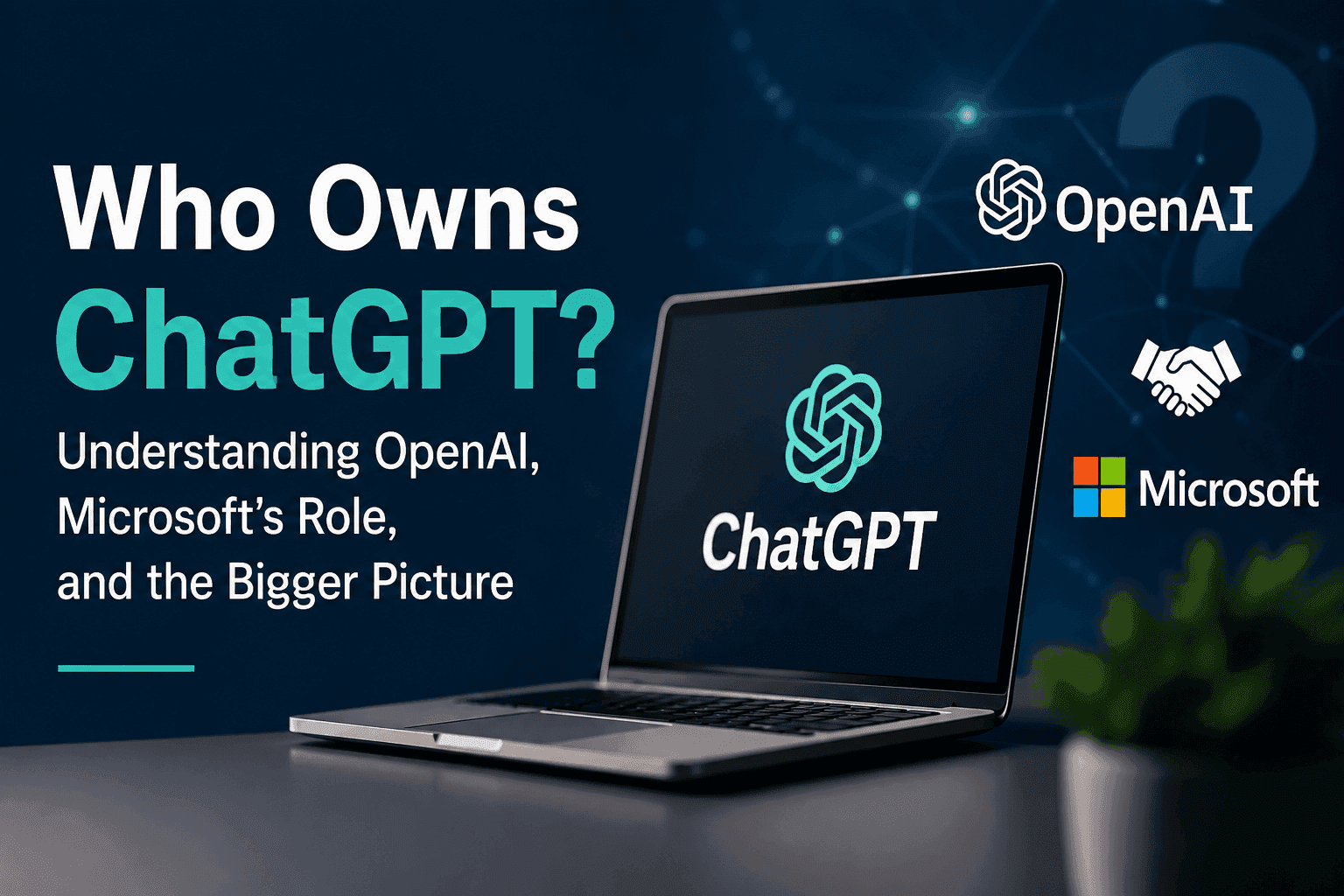
If you've ever paused mid-conversation with the chatbot and wondered who owns ChatGPT, you're asking a better question than you might think. The short answer is OpenAI. The longer answer involves a nonprofit foundation, a for-profit company, a very large Microsoft investment, and one of the more unusual corporate setups in tech.
This guide walks through it in plain language: who actually holds the keys, who just holds shares, and why the two aren't the same thing. By the end, you'll understand the ownership picture better than most headlines explain it.
The Quick Answer
ChatGPT is owned by OpenAI Group PBC, a public benefit corporation based in San Francisco. That for-profit company is controlled by a nonprofit called the OpenAI Foundation.
No single person owns ChatGPT. Microsoft is the largest outside shareholder, but it doesn't run the company. The nonprofit Foundation holds less equity than Microsoft yet keeps the real decision-making power. That gap between money and control is the part most people miss, and it's the key to understanding the whole structure.
A Short History of OpenAI
To see how the ownership got this complicated, it helps to follow the timeline.
- 2015: OpenAI launches as a nonprofit research lab. The mission, stated plainly, is to make sure advanced AI benefits everyone rather than a handful of shareholders. Early backers and founders included Sam Altman, Elon Musk, Greg Brockman, Ilya Sutskever, and others.
- 2019: Training large AI models turns out to be enormously expensive, far beyond what donations could cover. OpenAI creates a for-profit subsidiary with a "capped-profit" model, letting investors earn returns up to a limit. Microsoft signs on as a major investor around this time.
- 2022: ChatGPT launches in November and becomes a global phenomenon within weeks.
- October 2025: OpenAI completes a long-negotiated restructuring. The for-profit arm becomes OpenAI Group PBC, and the nonprofit is renamed the OpenAI Foundation. This is the structure in place today.
Each step was driven by the same tension: the company needed huge amounts of money to build AI, but it didn't want investors to fully take over its mission.
Who Owns ChatGPT Today?
After the October 2025 restructuring, ownership of OpenAI Group PBC breaks down into roughly three groups. The figures below come from OpenAI's own statements and reporting at the time of the deal.
| Stakeholder | Approx. equity stake | Role and influence |
|---|---|---|
| OpenAI Foundation (nonprofit) | ~26% | Controls the company. Appoints and can remove every board member of OpenAI Group PBC through special voting rights. |
| Microsoft | ~27% | Largest single shareholder by equity. Holds technology and commercial rights, but no board seats or governance control. |
| Employees & investors | ~47% | Current and former staff plus venture firms such as SoftBank, Nvidia, Thrive Capital, Sequoia Capital, and others. |
Worth verifying before you publish: OpenAI is a private company and these percentages were tied to its late-2025 valuation (around $500 billion at the time). Exact stakes can shift with new funding rounds, so confirm the latest figures from OpenAI's official "Our structure" page if you're citing specific numbers.
The headline detail here is striking: the group with the least equity of the three, the nonprofit Foundation, is the one calling the shots.
Why Owning Shares Isn't the Same as Control
This is the idea that trips up most explanations of who owns ChatGPT.
In a typical company, more shares usually mean more power. OpenAI deliberately broke that link. The OpenAI Foundation was given special governance rights, which means it appoints the entire board of directors of OpenAI Group PBC and can replace them whenever it chooses.
Microsoft and the venture investors, despite owning the majority of the equity between them, don't get board seats through their shares. They benefit financially if OpenAI grows in value, but they can't outvote the Foundation on the direction of the company.
There's also a public-mission twist. As a public benefit corporation (PBC), OpenAI Group is legally required to balance profit with its stated mission, rather than chasing returns at any cost. That's the same general structure Anthropic (the maker of Claude) uses, and it's still rare among large companies.
In short: investors own the upside, the Foundation owns the steering wheel.
Microsoft's Role, Explained
Microsoft's relationship with OpenAI is deep, but it's a partnership, not ownership of the whole thing.
Here's what Microsoft holds today:
- A roughly 27% stake in OpenAI Group PBC, its single largest external shareholding.
- Access to OpenAI's technology and models under a commercial agreement reported to run through 2032.
- A share of OpenAI's revenue until an independent panel verifies that artificial general intelligence (AGI) has been reached.
What Microsoft does not have is operational control or seats that let it direct OpenAI's mission. The two companies also loosened parts of their exclusivity over time, giving each more freedom to work with other partners.
So when someone says "Microsoft owns ChatGPT," that's not accurate. Microsoft is the biggest financial backer and a close partner, but OpenAI runs ChatGPT.
What About Sam Altman and the Founders?
Sam Altman is OpenAI's CEO and the most public face of the company. He shapes its strategy and direction day to day. Interestingly, whether he holds any meaningful personal equity has been a topic of ongoing discussion, and OpenAI has not publicly confirmed a large ownership stake for him. For a CEO of a company this valuable, that's unusual.
As for the other early names:
- Elon Musk co-founded and helped fund OpenAI in its first years but left the board in 2018 and no longer holds an ownership stake. He has since become a vocal critic and legal opponent of the company.
- Greg Brockman remains a central figure as a co-founder and leader.
- Several other early co-founders provided funding or guidance in the beginning but no longer hold governance roles.
The takeaway: ChatGPT isn't a founder-controlled company in the way Tesla or Meta are. It behaves more like an institution governed by a board than a startup steered by one owner.
Can You Buy ChatGPT Stock?
Not directly. OpenAI is a private company, so there's no "ChatGPT" or "OpenAI" ticker symbol you can buy on a stock exchange.
A few practical notes for anyone curious about investing:
- The most common way people get indirect exposure is by buying Microsoft (MSFT) shares, since Microsoft holds the largest outside stake in OpenAI.
- OpenAI's PBC structure does allow for a future initial public offering (IPO), and reporting in 2026 indicated the company had moved toward one. However, no confirmed listing date or terms were public at the time of writing.
Verify before publishing: IPO plans are fast-moving and sensitive. If your article touches on a public listing, confirm the current status directly from OpenAI or reputable financial news before you publish, because this can change quickly.
Be cautious of any website or "pre-IPO" offer claiming to sell you OpenAI shares directly. Those are common scam territory.
Who Owns What You Create With ChatGPT?
This is a different ownership question people often ask in the same breath, and the answer is friendlier than you'd expect.
Under OpenAI's Terms of Use, the company assigns ownership of the output you generate to you. You own your inputs (the prompts you type) and you own what ChatGPT produces in response to them.
A couple of fair-print details to keep in mind:
- Because many users can get similar responses to similar prompts, your ownership doesn't stop someone else from receiving near-identical output. You own your copy, not the idea exclusively.
- Whether AI-generated content can be copyrighted is a separate legal question that varies by country and is still evolving. If copyright matters for your work, check your local rules.
Common Mistakes to Avoid
When people talk about who owns the chat gpt platform, the same misunderstandings come up again and again. Steer clear of these:
- "Microsoft owns ChatGPT." Microsoft is the biggest investor, not the owner or operator. OpenAI controls the product.
- "It's just a normal company." OpenAI's nonprofit-controls-the-for-profit structure is genuinely unusual, and equity doesn't equal control here.
- "Elon Musk owns part of it." He co-founded OpenAI but left years ago and holds no stake today.
- "I can buy OpenAI stock." It's private. Any direct "OpenAI shares" offer to retail buyers deserves heavy skepticism.
- "The percentages are fixed." They're tied to private valuations and funding rounds, so they can move. Always check the latest official figures.
FAQ
Who owns ChatGPT? ChatGPT is owned by OpenAI Group PBC, a public benefit corporation controlled by the nonprofit OpenAI Foundation. No single person owns it.
Does Microsoft own ChatGPT? No. Microsoft is the largest outside shareholder (about 27%) and a major technology partner, but it doesn't control or operate the company.
Is ChatGPT owned by Google? No. Google is a competitor through its Gemini models. ChatGPT belongs to OpenAI.
Can I buy shares in OpenAI or ChatGPT? Not directly, since OpenAI is private. Some investors get indirect exposure through Microsoft stock. A future IPO is possible but was not confirmed with a date at the time of writing.
Who is the CEO of OpenAI? Sam Altman is the CEO. He leads strategy and direction, though OpenAI has not publicly confirmed a large personal equity stake for him.
Do I own what I make with ChatGPT? Yes. OpenAI's terms assign ownership of the output to you, though whether AI content can be copyrighted depends on your country's laws.
Final Takeaway
So, who owns ChatGPT? OpenAI does, through its for-profit OpenAI Group PBC, with the nonprofit OpenAI Foundation holding the real reins. Microsoft is the biggest financial backer, employees and investors hold the largest combined slice, and the mission-focused Foundation keeps control even with a minority stake.
It's a deliberately unusual setup, built to raise serious money without handing the mission to whoever writes the biggest check. Keep that money-versus-control distinction in mind and you'll understand OpenAI's structure better than most coverage explains it.
Curious to go deeper? Explore how OpenAI's models are built, how the company makes money, or how its structure compares to rivals like Anthropic and Google, and you'll have the full picture of the company behind the chatbot.
Amanda Hetler
Senior Editor