GPT-5.5 vs Claude Opus 4.8: Which AI Model Wins in 2026?
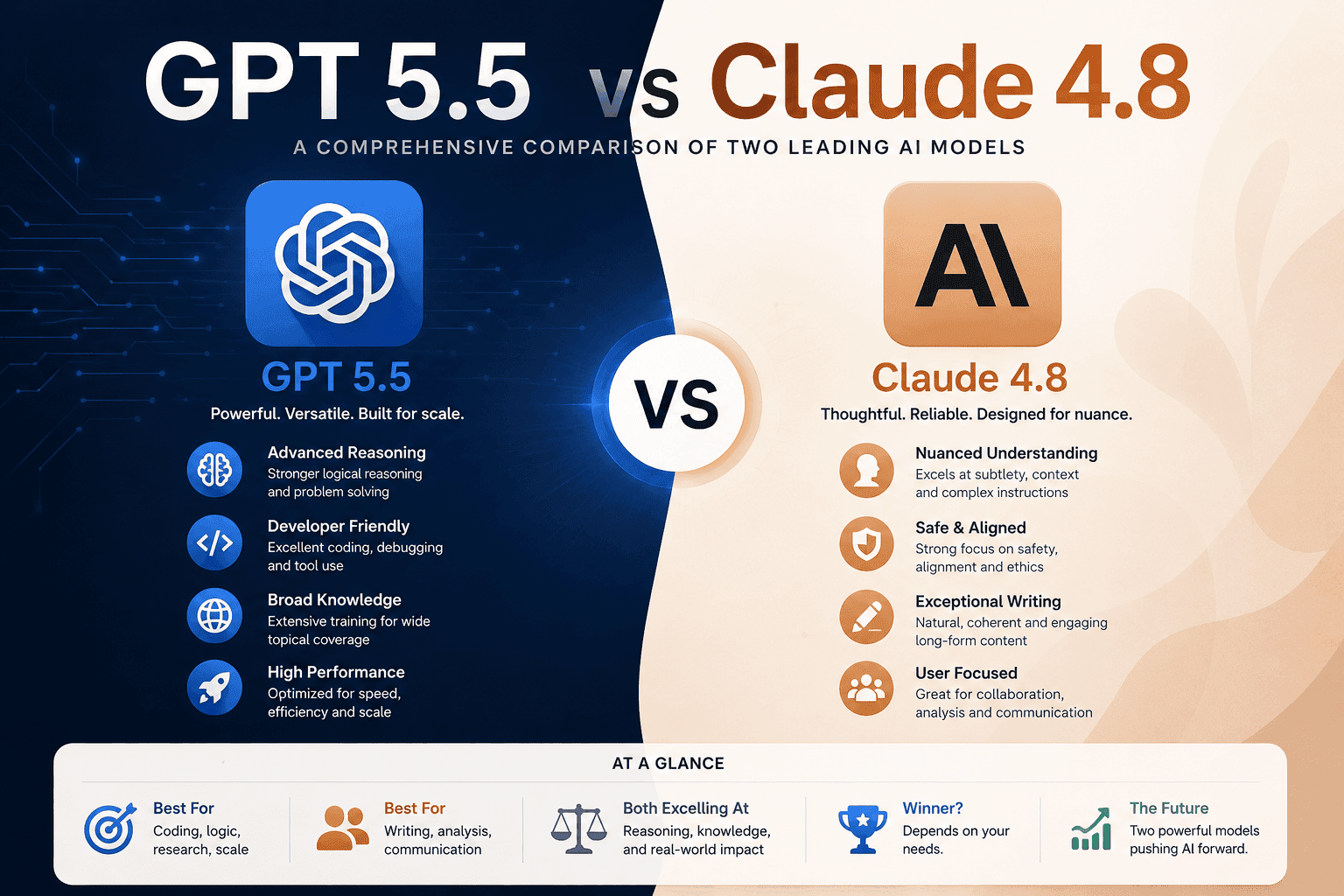
The AI race in 2026 has turned into a two-horse sprint at the very top, and the two names everyone keeps typing into search bars are GPT-5.5 and Claude Opus 4.8. Both arrived within weeks of each other, both promise smarter reasoning and stronger coding, and both are gunning for the same crown. So which one should you actually pay for? Let's break it down in plain English.
The Quick Verdict
If you want the short answer: Claude Opus 4.8 edges ahead on most knowledge-work and coding benchmarks, honesty, and price, while GPT-5.5 holds its own on terminal workflows, raw speed across a massive product ecosystem, and sheer reach. Neither is a blowout winner. The "best" model genuinely depends on what you're building.
Now let's get into the details, because the benchmark story is more interesting than either company's marketing makes it sound.
Release Timeline and Pricing
OpenAI shipped GPT-5.5 on April 23, 2026, just six weeks after GPT-5.4. That breakneck pace tells you everything about how fierce the competition has become. The model rolled out first to paying ChatGPT subscribers and Codex users, with API access following a day later. A more capable GPT-5.5 Pro variant is priced at a steep $30 per million input tokens and $180 per million output tokens, aimed squarely at enterprises that need maximum accuracy.
Anthropic answered on May 28, 2026 with Claude Opus 4.8. The company described it modestly as "a modest but tangible improvement" over Opus 4.7, but the pricing is where it really lands a punch: it stayed flat at $5 per million input tokens and $25 per million output tokens. That makes standard Opus 4.8 dramatically cheaper than GPT-5.5 Pro, which matters a lot once you're running real production workloads at scale.
Coding Performance
For most developers, coding is the deciding factor, and this is where Claude Opus 4.8 makes its strongest case.
On SWE-Bench Pro, the toughest variant of the popular software-engineering benchmark that uses real, actively maintained repositories, Opus 4.8 scored 69.2%, up from 64.3% on Opus 4.7 and comfortably ahead of GPT-5.5's 58.6%. On the standard SWE-bench Verified, Opus 4.8 hit 88.6%. Anthropic also says Claude Code paired with Opus 4.8 can now handle codebase-wide migrations across hundreds of thousands of lines, planning the work and carrying it through to merge.
GPT-5.5 isn't a slouch, though. It posted 82.7% on Terminal-Bench 2.0 and genuinely wins on terminal and command-line workflows, where it tends to be sharper and more efficient. If your team lives in the CLI and orchestrates agents that run shell commands all day, GPT-5.5 may feel snappier and more reliable for that specific job.
The pattern across roughly a dozen benchmarks: Claude leads on issue-level coding and agentic tool use, while GPT-5.5 takes terminal-style tasks. They're close enough that your own workflow will probably decide it more than any leaderboard.
Reasoning, Math, and Science
This is the most evenly matched arena. GPT-5.5 came out swinging on mathematics, scoring 51.7% on FrontierMath Tiers 1 to 3 and 35.4% on the brutal Tier 4, plus strong results on advanced reasoning. OpenAI has consistently positioned its frontier models as math and research powerhouses, and GPT-5.5 continues that.
Claude Opus 4.8 closed much of that historic gap. It now sits slightly ahead of both OpenAI and Google on Humanity's Last Exam, a notoriously hard reasoning test, and it overtook Gemini 3.1 Pro on CritPt, a frontier physics evaluation, though it still trails GPT-5.5 there. On agentic knowledge work, Anthropic's GDPval-AA evaluation gave Opus 4.8 an implied win rate of about 67% head-to-head against GPT-5.5. The two are roughly tied on graduate-level science.
Honesty and Hallucinations
Here's the differentiator that doesn't show up in a flashy benchmark headline but matters enormously in real use: trustworthiness.
Anthropic leaned hard into honesty with Opus 4.8. The company reports the model is around four times less likely than its predecessor to let flaws in its own code slip by unremarked, and its hallucination rate held roughly flat at about 36% while accuracy improved. Anthropic continues to show meaningfully lower hallucination rates than its rivals. The practical upside is a model that tells you when it's stuck or unsure rather than confidently inventing an answer, which saves real debugging time.
OpenAI also made progress here. GPT-5.5 Instant, the new default in ChatGPT, was tuned to reduce hallucinations in sensitive areas like law, medicine, and finance while keeping latency low. So both labs are taking reliability seriously, but Anthropic's lead on calibrated self-doubt is one of Opus 4.8's most quoted strengths.
Features and Ecosystem
GPT-5.5 benefits from OpenAI's enormous footprint, with ChatGPT serving more than 900 million weekly active users. GPT-5.5 Instant can now pull from past conversations, files, and Gmail for more personalized answers, and OpenAI keeps pushing toward an agentic "super app" vision.
Claude Opus 4.8 introduced an effort-control dial right next to the model picker, letting you choose how hard the model thinks. Crank it up for deeper reasoning, turn it down for faster, cheaper responses. Anthropic also shipped dynamic workflows that can spin up hundreds of parallel subagents, and a fast mode that became roughly three times cheaper than before.
So, Which Should You Choose?
Pick Claude Opus 4.8 if you prioritize coding reliability, honest self-checking, long-context knowledge work, and a lower price per token. Pick GPT-5.5 if you want strong math and research, terminal-heavy agent workflows, and tight integration with the broader ChatGPT ecosystem and its memory features.
The honest takeaway for 2026: these models are closer than the hype suggests, and the gap shifts with every six-week release cycle. Many serious teams now keep both on hand and route each task to whichever model handles it best. If you can, test both on your own workload before committing. The benchmarks point you in a direction, but your actual use case casts the deciding vote.
Amanda Hetler
Senior Editor