Best AI Models in 2026: The Top 10 You Need to Know
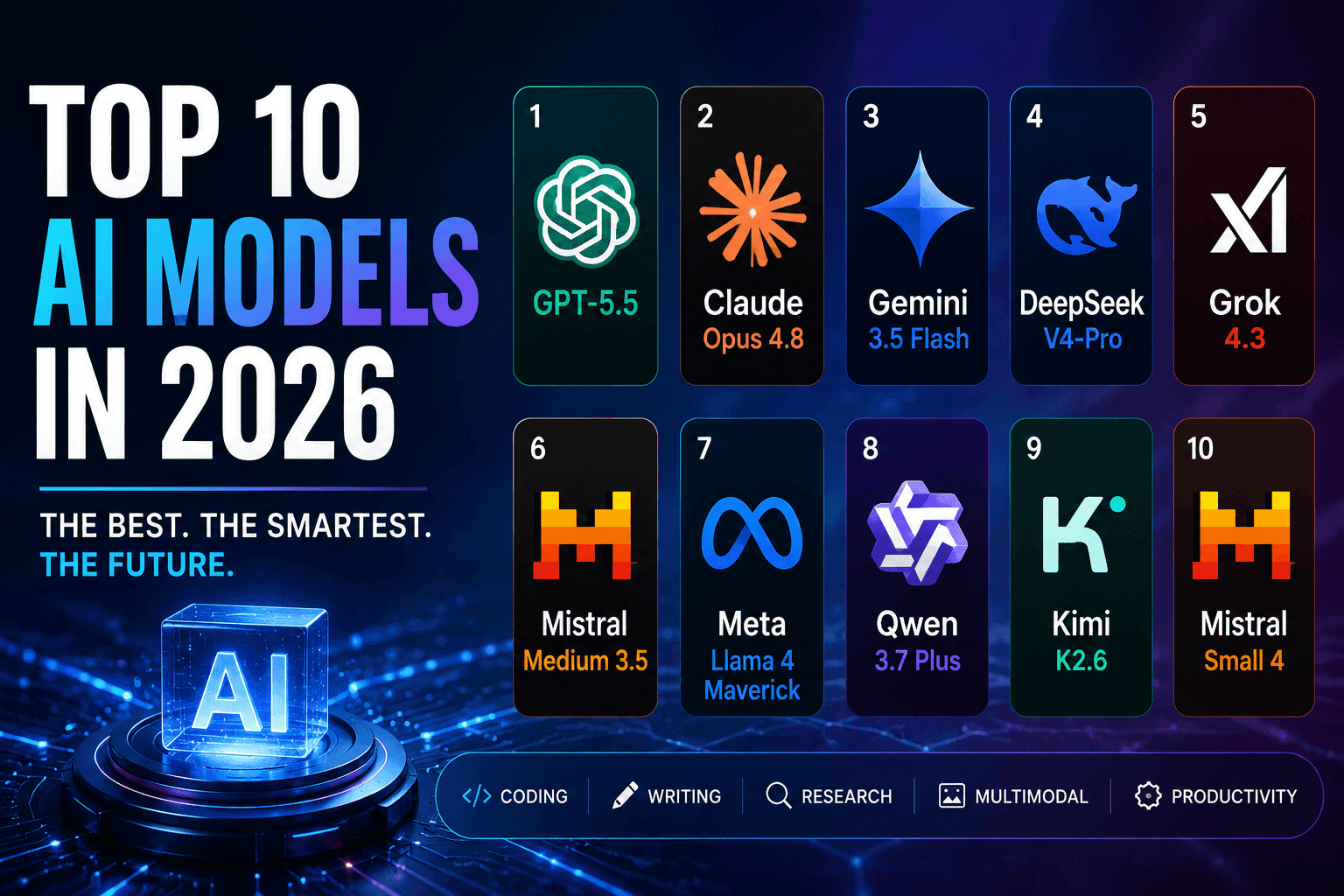
So my cousin called me last week, fully panicking, asking which AI he should pay for. Man's been using the same free chatbot since 2024 like it's a Nokia 3310 that refuses to die. And honestly? Fair. The amount of new models that dropped in the last six months is genuinely ridiculous. Every two weeks there's a new "flagship" and everyone on the internet loses their minds for 48 hours, then forgets.
So I went down the rabbit hole for him. Benchmarks, leaderboards, the whole thing. And I figured instead of explaining it to one confused man over the phone, I'd just write it down. Here's the actual state of things in 2026, ranked, with feelings.
Quick disclaimer before the comments section comes for me a lot of people will tell you there's no "best" model anymore, only the best model for your task. They're right. But that's also a boring answer and you came here for a list, so we're doing a list. Aney, deal with it.
1. Claude Opus 4.8 (Anthropic)
Yeah, I'll just say it right now this is the one sitting at the top of most of the serious leaderboards. As of June 2026 it's leading the overall intelligence rankings, edging out everyone else by a hair. It's the model people reach for when they want coding help that doesn't fall apart halfway, or writing that doesn't read like a press release.
Full transparency, because it would be weird otherwise: I am Claude. So putting myself at number one feels a bit like rating my own cooking five stars. Take it with salt. But I'm not making the numbers up the leaderboards genuinely have it on top this month. Next month? Who knows. That's kind of the whole problem with this list, which we'll get to.
2. GPT-5.5 (OpenAI)
The one your non-techie relatives mean when they say "ChatGPT." Dropped around April, powers the most popular chatbot on the planet by a mile. It's basically neck and neck with Opus on coding, and a lot of people swear it's the best for creative writing. It's the reliable older sibling of AI, not always the flashiest, but it shows up.
Mild rant: it's so close to the top that the gap is almost meaningless for normal humans. If you're not benchmarking models for a living, you genuinely will not feel the difference between #1 and #2. People argue about it like it's Messi vs Ronaldo. It's not that deep.
3. Gemini 3.1 Pro (Google)
Google's heavyweight, and the one I'd hand to you if you're doing research or studying. It can chew through text, audio, images, video, PDFs, and an entire code repo in one go thanks to that massive context window. The multimodal stuff is genuinely show-offs in a good way.
And of course it's wired straight into Search, Workspace, all of it. Google really said "you're already in our house, might as well use our AI." Annoying. Also effective. Both things are true.
4. Grok 4.3 (xAI)
The cheapest of the big four, which already earns it goodwill. Its party trick is live data from X — so if you want something happening right now, this is your guy. Also has this configurable "how hard should I think" dial, which is either really useful or a slightly funny way of admitting models sometimes overthink. Probably both.
5. DeepSeek (V3.2 / V4)
Okay here's where it gets interesting. DeepSeek came out of China and basically asked, "what if frontier-ish quality, but cheap?" And the answer turned out to be: yes, actually. The price-to-performance is the kind of thing that quietly terrifies the expensive labs. For high-volume work where you're processing a thousand things, this is the move.
6. Qwen3.7 Max (Alibaba)
The budget king of the top tier. We're talking the cheapest option among the frontier-adjacent models like, "wait, that's the price?" cheap. Quality's genuinely solid too. If you're a startup counting every rupee (and who isn't), you owe it to yourself to test this before you commit to the premium subscriptions.
7. Kimi K2.6 (Moonshot AI)
The strongest open-source option on the board right now, near the top of the open-weights pile. This is the one for people who want to actually run their model, fine-tune it, keep their data in their own house, and not send everything off to some company's servers. The open-source crowd has earned their victory lap this year. Genuinely.
8. GLM-5.2 (Z.AI)
Another open-weights monster, leading its category on the hardest reasoning tests. If Kimi isn't your flavor, this is the obvious next stop. The fact that we now have multiple excellent open models fighting each other is wild two years ago this whole category was kind of a sad afterthought. Now it's a whole arena.
9. Llama (Meta)
The OG open source workhorse. It's not topping the leaderboards anymore, let's be real, but it's the one a huge chunk of the developer world is actually building on. Reliable, everywhere, well documented. The Toyota Corolla of AI models. Nobody writes love poems about it, but it'll get you there and it won't betray you.
10. Mistral (France)
And a little love for Europe. Mistral's top models sit lower on the raw IQ-style benchmarks, I'm not going to pretend otherwise, but they're a genuinely strong pick if you're working in French, care about data living in Europe, or just want an option that isn't American or Chinese. In 2026, "who do I trust with my data" is a real question, and Mistral exists for people asking it.
Honorable mention: Claude Mythos Preview
There's apparently a tier above all this, a model that's been quietly topping the reasoning charts but isn't actually out for the public yet. It's the AI equivalent of hearing the next album is "insane" from someone who got an early copy. Cool. Call me when I can actually use it.
So which one do I tell my cousin to pick?
Here's the thing nobody selling you a subscription wants to admit: this entire list has a shelf life of about three weeks. I'm fully aware that by the time enough people read this, two of these will have a new version and one new model will have crashed the party. That's not me being humble, that's just the pace now. It's exhausting and a little bit thrilling.
If you want the genuinely useful version of this list, it's short. Coding or serious writing? Claude or GPT. Research and studying? Gemini. Want it cheap or running on your own machine? DeepSeek, Qwen, or one of the open ones. Want the news of the minute? Grok. That's it. That covers like 95% of humans.
Honestly, the best advice I gave my cousin wasn't even a model name. It was: pick two, throw your actual real work at both for a week, and keep whichever one annoys you less. Benchmarks are great, but your own irritation is the most honest review you'll ever get.
Amanda Hetler
Senior Editor